





Introduction
Minimal residual disease (MRD) negativity is one of the most important measures of treatment success in multiple myeloma (MM) and is associated with improved progression-free and overall survival. Current MRD assessments are typically performed using bone marrow samples, which are invasive and difficult to repeat frequently.
Peripheral blood-based mass spectrometry (MS) offers a promising non-invasive method for monitoring M-protein over time. Two leading MS approaches are:
- EXENT: An intact immunoglobulin mass spectrometry assay that measures circulating M-protein and offers high throughput.
- EasyM: A personalized clonotypic peptide assay that sequences each patient’s unique M-protein and tracks disease using highly sensitive peptide-based monitoring.
Although both technologies are designed to monitor M-protein in blood, direct comparisons between EasyM and EXENT have been limited.
Study Summary
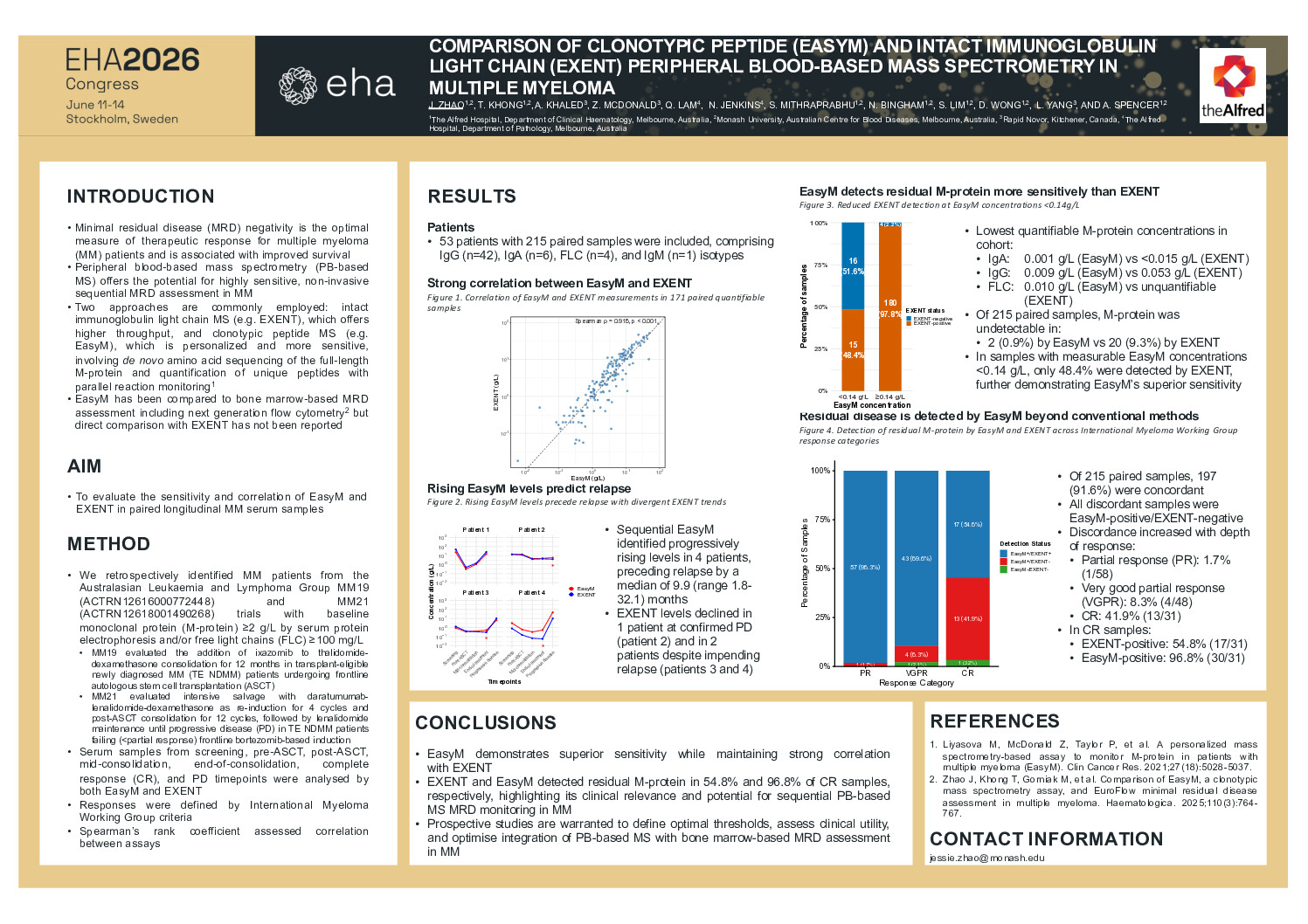
This retrospective analysis compared the performance of EasyM and EXENT in paired serum samples collected from patients enrolled in the Australasian Leukaemia and Lymphoma Group MM19 and MM21 clinical trials.
Eligible patients had measurable disease at baseline, defined as:
- M-protein ≥2 g/L by serum protein electrophoresis (SPEP), and/or
- Free light chain (FLC) ≥100 mg/L
The study included 53 patients and 215 paired serum samples collected longitudinally throughout treatment.
Patient isotypes included:
- IgG (n=42)
- IgA (n=6)
- Free light chain (FLC) (n=4)
- IgM (n=1)
Samples were evaluated at multiple treatment milestones including screening, pre- and post-autologous stem cell transplant (ASCT), during consolidation therapy, complete response (CR), and progressive disease (PD).
Key Findings
Strong agreement between EasyM and EXENT
- Across 171 quantifiable paired samples, EasyM and EXENT demonstrated a very strong correlation.
- Spearman correlation coefficient:
- ρ = 0.918
- p < 0.001
This indicates that both assays generally track M-protein levels similarly across a wide range of concentrations.
EasyM demonstrated superior analytical sensitivity
- Of 215 paired samples:
- 197 (91.6%) were concordant
- All discordant samples were EasyM-positive and EXENT-negative
- No samples were EXENT-positive and EasyM-negative
This suggests that whenever the assays disagreed, EasyM detected low levels of M-protein that were below the detection limit of EXENT.
Discordance increased with deeper responses
As patients achieved deeper responses to treatment, EasyM continued detecting M-protein more frequently than EXENT:
- Partial Response (PR):
- Discordance: 1.7% (1/58)
- Very Good Partial Response (VGPR):
- Discordance: 8.3% (4/48)
- Complete Response (CR):
- Discordance: 41.9% (13/31)
The difference between assays became most apparent in patients with very low levels of circulating M-protein.
Detection in complete response
Among patients classified as being in complete response (CR) by International Myeloma Working Group criteria:
- EasyM detected M-protein in 30 of 31 samples (96.8%)
- EXENT detected M-protein in 17 of 31 samples (54.8%)
These findings suggest that highly sensitive clonotypic mass spectrometry can detect very low levels of M-protein even after patients achieve a conventional complete response, highlighting its greater analytical sensitivity compared with intact immunoglobulin mass spectrometry.
EasyM detects M-protein at very low concentrations
- When EasyM concentrations were below 0.14 g/L, EXENT failed to detect M-protein in approximately half of samples.
- At concentrations ≥0.14 g/L, EXENT detection was nearly universal.
This indicates that EasyM maintains detection at very low M-protein concentrations where EXENT frequently becomes negative.
Rising EasyM levels may predict relapse earlier
Longitudinal patient analyses showed that increasing EasyM levels preceded clinical relapse in several patients, even when EXENT measurements remained stable or showed divergent trends.
This suggests EasyM may provide earlier warning of disease recurrence and could potentially support earlier clinical intervention.
Authors
J. Zhao, T. Khong, Abir Khaled, Zac McDonald, Q. Lam, N. Jenkins, S. Mithraprabhu, N. Bingham, S. Lim, D. Wong, Liqiang Yang, and Andrew Spencer.
Contact Us.
We want to make an impact on myeloma.
We welcome discussion with academic investigators, pharmaceutical companies, patient groups and related service providers. Please reach out.
Talk to Our Scientists.
We Have Sequenced 5000+ Antibodies and We Are Eager to Help You.
Through next generation protein sequencing, Rapid Novor enables timely and reliable discovery and development of novel reagents, diagnostics, and therapeutics. Thanks to our Next Generation Protein Sequencing and antibody discovery services, researchers have furthered thousands of projects, patented antibody therapeutics, and ran the first recombinant polyclonal antibody diagnostics