





Introduction
Chimeric antigen receptor (CAR) T-cell therapy produces high overall response rates (ORR) and can induce durable remissions in relapsed/refractory multiple myeloma (MM), raising the possibility of long-term disease control or cure. However, standard response assessments have limited ability to identify patients with exceptional outcomes early after CAR T therapy.
Bone marrow-based measurable residual disease (MRD) testing using clonoSEQ provides important prognostic information but requires invasive and costly sampling, making it impractical for frequent monitoring and typically performed only periodically (often around once a year in routine practice). EasyM, a clonotypic mass spectrometry (CT-MS) assay, is a highly sensitive and specific blood-based approach that tracks patient-specific M-proteins and can be performed much more frequently throughout treatment, offering a less invasive method for longitudinal residual disease monitoring following CAR T therapy.
Study Summary
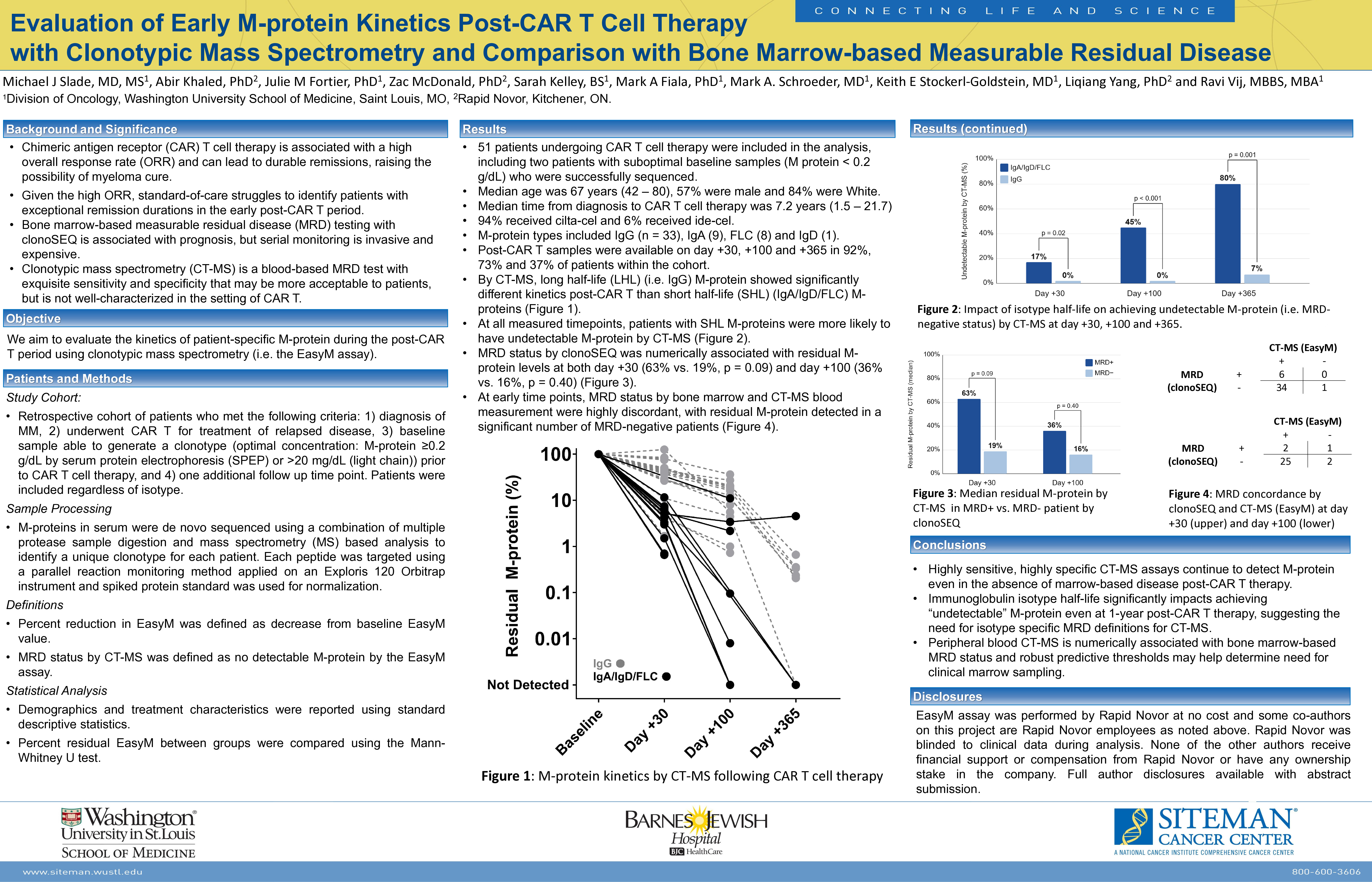
This retrospective study evaluated M-protein kinetics following CAR T-cell therapy using the EasyM clonotypic mass spectrometry assay. Eligible patients had a diagnosis of multiple myeloma, underwent CAR T therapy for relapsed disease, had a baseline sample sufficient for clonotype generation, and at least one post-treatment follow-up sample. M-proteins were de novo sequenced to identify unique patient-specific clonotypes, which were subsequently tracked using targeted mass spectrometry methods.
Residual disease was assessed by measuring changes in EasyM levels from baseline. CT-MS MRD negativity was defined as the absence of detectable M-protein. Results were compared with bone marrow MRD assessments performed using clonoSEQ.
A total of 51 patients treated with CAR T-cell therapy were included in the analysis.
Key Findings
Patient characteristics
- 51 patients included in the study
- Age range 42-80, 57% male, 84% White
- Median time from diagnosis to CAR T therapy: 7.2 years
- CAR T products:
- 94% received cilta-cel
- 6% received ide-cel
Disease characteristics
- M-protein isotypes:
- IgG (n=33)
- IgA (n=9)
- Free light chain (FLC) (n=8)
- IgD (n=1)
- Two patients with suboptimal baseline M-protein levels were successfully sequenced and included
Sample availability
- Day +30 samples available for 92% of patients
- Day +100 samples available for 73%
- Day +365 samples available for 37%
M-protein clearance kinetics
- Significant differences were observed between long half-life (LHL) M-proteins (primarily IgG) and short half-life (SHL) M-proteins (IgA, IgD, and FLC)
- SHL M-proteins cleared more rapidly after CAR T therapy
- Patients with SHL M-proteins were more likely to achieve undetectable EasyM results at all evaluated timepoints
Comparison with bone marrow MRD
- Residual EasyM levels were numerically associated with clonoSEQ MRD status:
- Day +30: 63% residual EasyM in MRD-positive patients vs. 19% in MRD-negative patients (p=0.09)
- Day +100: 36% vs. 16% (p=0.40)
- Early after CAR T therapy, substantial discordance was observed between blood-based CT-MS and bone marrow MRD results
- Many patients who were MRD-negative by clonoSEQ continued to have detectable M-protein by EasyM
Clinical implications
- Persistent M-protein detection by CT-MS may reflect delayed immunoglobulin clearance rather than active disease
- Immunoglobulin half-life appears to significantly influence MRD interpretation following CAR T therapy
- Peripheral blood CT-MS demonstrates potential as a non-invasive tool for monitoring disease burden and may help guide decisions regarding bone marrow MRD testing
Authors
Michael J. Slade, Abir Khaled, Julie M. Fortier, Zac McDonald, Sarah Kelley, Mark A. Fiala, Mark A. Schroeder, Keith E. Stockerl-Goldstein, Liqiang Yang, and Ravi Vij.
Contact Us.
We want to make an impact on myeloma.
We welcome discussion with academic investigators, pharmaceutical companies, patient groups and related service providers. Please reach out.
Talk to Our Scientists.
We Have Sequenced 5000+ Antibodies and We Are Eager to Help You.
Through next generation protein sequencing, Rapid Novor enables timely and reliable discovery and development of novel reagents, diagnostics, and therapeutics. Thanks to our Next Generation Protein Sequencing and antibody discovery services, researchers have furthered thousands of projects, patented antibody therapeutics, and ran the first recombinant polyclonal antibody diagnostics