





Introduction
Ciltacabtagene Autoleucel (cilta-cel) produces high response rates in multiple myeloma (MM), but most patients eventually relapse, emphasizing the need for sensitive, frequent, and reliable minimal residual disease (MRD) monitoring. Traditional bone marrow-based MRD assessments face multiple challenges: they can miss disease due to spatial heterogeneity, suffer from hemodilution, are difficult to perform frequently, and often fail to capture extramedullary disease, limiting their reliability for guiding clinical decisions.
EasyM, a blood-based mass spectrometry assay, offers a potential solution to these challenges. By sequencing patient-specific M-protein peptides to create a unique “clonotypic fingerprint,” EasyM allows non-invasive, frequent, and quantitative MRD monitoring. Data shows that EasyM can detect residual disease at sensitivities comparable to bone marrow-based MRD assays at the 10⁻⁶ level, while overcoming the sampling limitations and practical constraints.
Study Summary
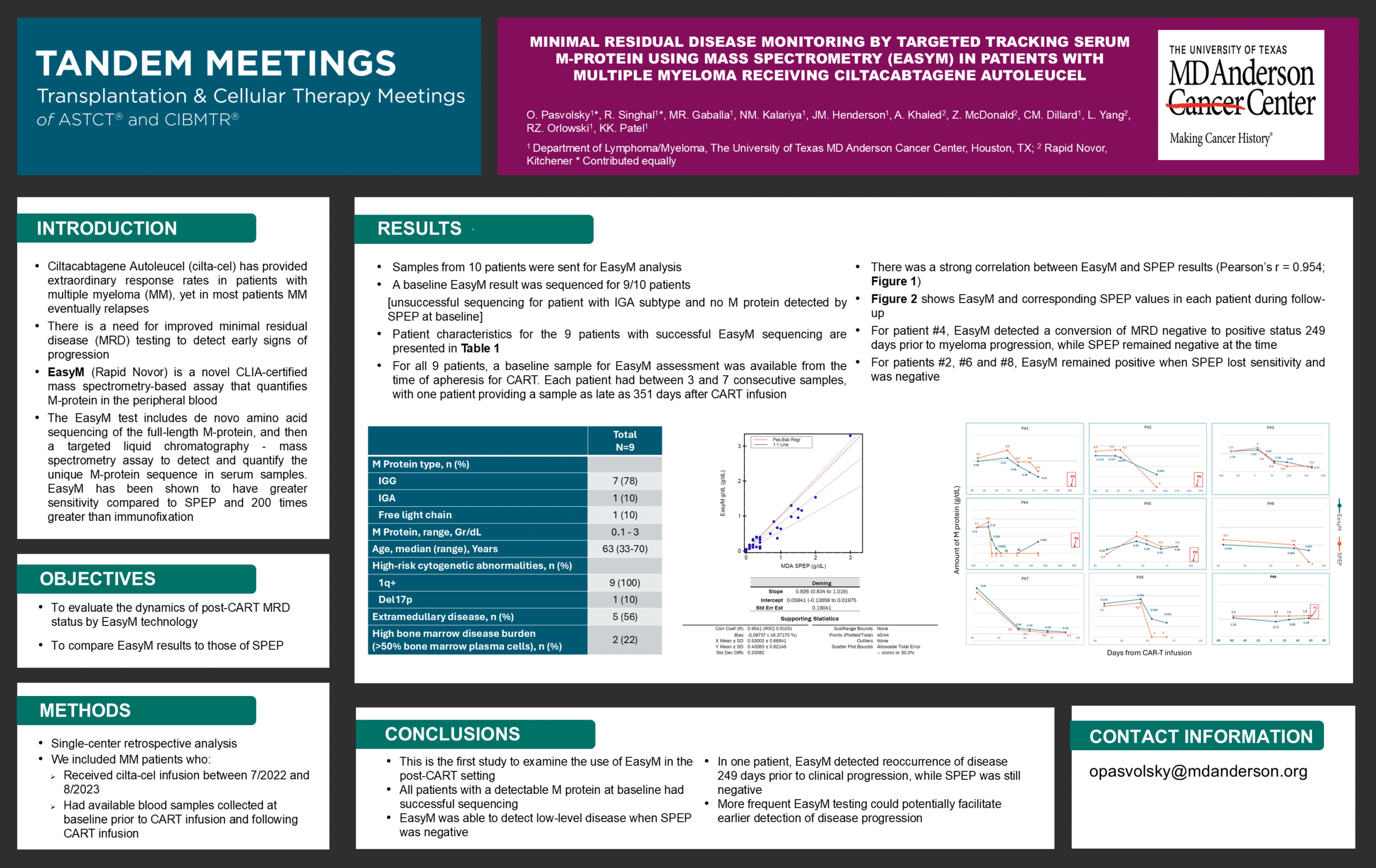
This single-center retrospective study evaluated EasyM for longitudinal MRD monitoring in MM patients treated with cilta-cel CAR-T therapy. Ten patients with available baseline and follow-up serum samples were analyzed. EasyM results were compared to standard SPEP measurements across multiple timepoints post-infusion.
Key Findings
-
High feasibility: Successful M-protein sequencing in 9/10 patients (all patients with a detectable M protein at baseline had successful sequencing)
-
Strong correlation with SPEP: Pearson’s r = 0.954
-
Improved sensitivity:
-
EasyM detected disease when SPEP was negative
-
Remained positive in multiple patients after SPEP lost sensitivity
-
-
Earlier relapse detection:
-
Detected MRD conversion 249 days before clinical progression in one patient
-
-
Longitudinal monitoring:
-
Up to 351 days of follow-up with consistent tracking
-
Authors
Oren Pasvolsky, Ruchi Singhal, Mahmoud Gaballa, Nilesh Kalariya, Jared Henderson, Abir Khaled, Zac McDonald, Christen Dillard, Liqiang Yang, Robert Orlowski, Krina K. Patel
Contact Us.
We want to make an impact on myeloma.
We welcome discussion with academic investigators, pharmaceutical companies, patient groups and related service providers. Please reach out.
Talk to Our Scientists.
We Have Sequenced 5000+ Antibodies and We Are Eager to Help You.
Through next generation protein sequencing, Rapid Novor enables timely and reliable discovery and development of novel reagents, diagnostics, and therapeutics. Thanks to our Next Generation Protein Sequencing and antibody discovery services, researchers have furthered thousands of projects, patented antibody therapeutics, and ran the first recombinant polyclonal antibody diagnostics