





Introduction
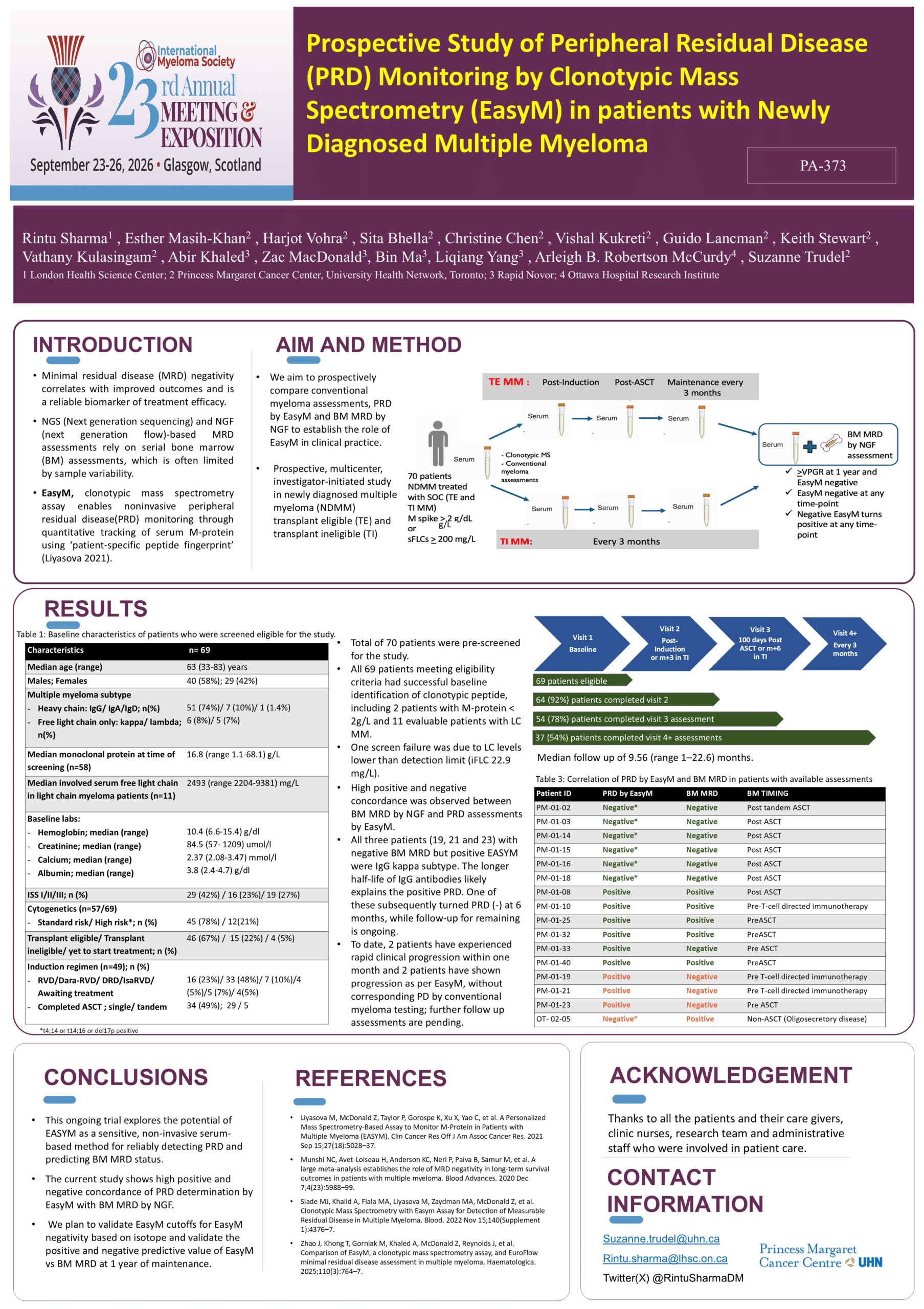
Minimal residual disease (MRD) negativity is associated with improved long-term outcomes in patients with multiple myeloma (MM). However, conventional MRD assessments using next-generation flow (NGF) or next-generation sequencing (NGS) rely on bone marrow sampling, which is invasive and subject to sampling variability, limiting the feasibility of frequent monitoring.
EasyM, a clonotypic mass spectrometry (CT-MS) assay, enables non-invasive peripheral residual disease (PRD) monitoring by quantitatively tracking patient-specific peptides associated with serum monoclonal protein (M-protein). This blood-based approach may provide a practical alternative or complement to bone marrow MRD assessment, allowing longitudinal disease monitoring throughout treatment.
Study Summary
This prospective, multicenter, investigator-initiated study evaluated EasyM for PRD monitoring in patients with newly diagnosed multiple myeloma (NDMM), including both transplant-eligible and transplant-ineligible patients. The study aimed to compare conventional myeloma assessments and EasyM-based PRD measurements with bone marrow MRD assessed by NGF to determine the potential role of EasyM in clinical practice.
Patient-specific clonotypic peptides were identified at baseline and subsequently tracked using EasyM to monitor changes in serum M-protein levels. Assessments were conducted at baseline, after induction therapy or at month 3 for transplant-ineligible patients, approximately 100 days after autologous stem cell transplantation (ASCT) or at month 6 for transplant-ineligible patients, and every three months thereafter.
A total of 71 patients were pre-screened, of whom 70 met eligibility criteria and had successful baseline clonotypic peptide identification. The study remains ongoing, with a median follow-up of approximately 9.6 months.
Key Findings
Patient characteristics
-
70 eligible patients included in the study
-
Median age: 63 years (range 33–83)
-
58% male and 42% female
-
67% transplant-eligible and 22% transplant-ineligible; 5% had yet to start treatment
-
21% of patients with available cytogenetic data had high-risk cytogenetic abnormalities
Disease characteristics
-
M-protein subtypes:
-
IgG: 51 patients (74%)
-
IgA: 7 patients (10%)
-
IgD: 1 patient (1.4%)
-
Kappa free light chain: 6 patients (8%)
-
Lambda free light chain: 5 patients (7%)
-
-
Median baseline monoclonal protein concentration was 16.8 g/L among 58 evaluable patients.
-
All 70 eligible patients had successful baseline identification of their patient-specific clonotypic peptide, including two patients with M-protein levels below 2 g/L and 11 evaluable patients with light-chain multiple myeloma.
-
One screened patient was excluded because free light-chain levels were below the assay’s detection limit.
Sample availability and follow-up
-
92% of patients completed visit 2 assessments.
-
78% completed visit 3 assessments.
-
54% completed visit 4 or later assessments.
-
Median follow-up was 9.56 months (range 1–22.6 months).
Comparison with bone marrow MRD
-
High positive and negative concordance was observed between EasyM-based PRD assessments and bone marrow MRD measured by NGF.
-
Three patients had positive EasyM results despite negative bone marrow MRD. All three had IgG-kappa myeloma.
-
The investigators suggested that the longer half-life of IgG antibodies could explain persistent EasyM positivity despite negative bone marrow MRD.
-
One of these three patients subsequently became PRD-negative at six months, while follow-up for the other two was ongoing.
Clinical progression and implications
-
Two patients experienced rapid clinical progression within one month.
-
Two patients showed progression according to EasyM without corresponding progression detected by conventional myeloma testing; additional follow-up was pending.
-
These preliminary observations suggest that EasyM may provide complementary information about disease progression between conventional assessments.
-
Persistent M-protein detection should be interpreted in the context of immunoglobulin clearance kinetics, particularly for IgG subtypes.
Authors
Rintu Sharma, Esther Masih-Khan, Harjot Vohra, Sita Bhella, Christine Chen, Vishal Kukreti, Guido Lancman, Keith Stewart, Vathany Kulasingam, Abir Khaled, Zac MacDonald, Bin Ma, Liqiang Yang, Arleigh B. Robertson McCurdy, Suzanne Trudel.
Contact Us.
We want to make an impact on myeloma.
We welcome discussion with academic investigators, pharmaceutical companies, patient groups and related service providers. Please reach out.
Talk to Our Scientists.
We Have Sequenced 5000+ Antibodies and We Are Eager to Help You.
Through next generation protein sequencing, Rapid Novor enables timely and reliable discovery and development of novel reagents, diagnostics, and therapeutics. Thanks to our Next Generation Protein Sequencing and antibody discovery services, researchers have furthered thousands of projects, patented antibody therapeutics, and ran the first recombinant polyclonal antibody diagnostics